Tuesday, July 12, 2011

Websites for Writers


I stumbled across these editing tips by Tracey Neithercott a while back and thought they were excellent. Then I reminded myself to write down the name of the blog so I could share it and not be plagiarizing anything.

This is some great advice. Editing can be such a struggle for me. Oh I’m good at recognizing problems with the plot and figuring out which words I just use too much. But there’s so much more to do to make my books readable, let alone publishable.

I really loved the bit about highlighting verbs and circling metaphors. I think there would be quite a large amount of yellow in my book : ). Also smart is the suggestion to read the book through for every—repeat, every—character. Thinking of each one as a main character (albeit one who doesn’t need every moment told) will help develop them and the story. If you can’t create someone who is a character and not a plot device, then out they go.

Any self-editing tips you want to add? What do you do in order to develop each character?

Sunday, July 10, 2011

Award Time


Because, why not? I have a lot of good writer/blogger friends and it’s good to acknowledge their awesomeness.

Deirdra Eden-Coppel at A Storybook World gave me the Fantastic Fantasy Award:


Isn’t it pretty? She drew it herself, which makes it even more special. Thank you, Deirdra!

But she isn’t the only one to have given me an award recently. My good blogging buddy Su presented me with the Versatile Blogger award. 


First of all, thank you. It’s always nice to receive an award. It’s like a hug over the internet. Anyway, the rules for this award are simple: 1. List seven random facts about yourself. 2. Pass it on. Simple enough.

1. I love comics and cartoons. When I was little, I wanted to be an artist when I grew up. Unfortunately, that requires the ability to draw.
2. I don’t like the taste of coffee. But I do enjoy the smell.
3. I spelled versatile wrong when I first typed it. I had to use Spell Check to get it right.
4. When I was twenty two, I went into a restaurant with my family (I’m the youngest, mind you) and the Hostess asked me if I wanted a children’s menu. Twenty two.
5. My favorite show that’s still on the air is American Dad! It’s just so absolutely ridiculous.
6. Does anyone remember the old SCARY STORIES books? There’s one story about a girl with a spider nest in her face. I’m pretty sure that picture is what scared me off spiders.
7. This probably isn’t new information, but I get most of my story ideas from dreams.

And now, I’m passing it on to…

M.J. Fifield! Yes, only one person. Because that’s how I roll. And she’s awesome.

Friday, July 8, 2011

The Language of Confusion: Un-Bear-Able

I’m pretty sure I chose this word just so I could use that title.

Anyway, bear is another one of those weird words that has two discrete meanings. One is a large animal, the other is a synonym for endure. And let’s not forget bear as a synonym for birth. There has to be a reason these words spell and sound the same, right?

Wrong. Nothing is logical in linguistics.

Both bears come from Old English. Bear (the verb) is from beran and bear (the animal) from bera. Still pretty close. Further back, in Proto Germanic, you get beranan and beron respectively. Beranan has a similar meaning to endure, give birth to. But beron actually means “the brown one” (brown is actually brunazin Proto Germanic; pretty close to what we call the animal).

Of course, then the two etymologies go back to being one. Just like in English, the Proto Indo European bher has more than one meaning, both endure and brown. It’s worth noting, however, that bher is not the word for bear (animal)—that word is rtko. No, I have no idea how to pronounce that.

I would say we have the Germans to thank for picking the animal’s brown fur for its name. Brown bears are still found in Europe and I guess they chose one of its most distinguishing characteristics. I guess it was a tough choice between “brown” and “furred death machine.”  

Thanks to the Online Etymology Dictionary and the Bear Planet site for the info.

Tuesday, July 5, 2011

Websites for Writers…Maybe Not

The other day, I received an email from Dropbox saying they changed their Terms of Service. Normally this isn't a big deal, but it has serious implications for us writers: Dropbox has changed their terms of service to give them free license to whatever you upload. Check out their Terms of Service and go to the section marked Your Stuff & Your Privacy.

“We sometimes need your permission to do what you ask us to do with your stuff (for example, hosting, making public, or sharing your files). By submitting your stuff to the Services, you grant us (and those we work with to provide the Services) worldwide, non-exclusive, royalty-free, sublicenseable rights to use, copy, distribute, prepare derivative works (such as translations or format conversions) of, perform, or publicly display that stuff to the extent we think it necessary for the Service. You must ensure you have the rights you need to grant us that permission.”

(Bolding is my own)

Now, I understand they need permission to reproduce your work if, say, it’s part of a file share and they need to copy it for the other computers that belong to the network. But, correct me if I’m wrong, they are saying that by backing up your files on Dropbox, they can publicly display it and they don’t need your permission. Not that I think they would. I just don’t like that they can do it at all.

Surely there is some middle ground between never copying the work (which would defeat the purpose of an internet backup) and having license to publicly display it. Is that really necessary?

Maybe this is a little paranoid, but I’m not using Dropbox anymore and I’m retracting my recommendation for it. Right now, the only one with authority to display my work is me, and I’m keeping it that way.

What do you think of these new terms of service? What do you use to back up your work?

Sunday, July 3, 2011

The Other WIP


By that I mean “Writer in Progress.” See, becoming an interesting, readable writer doesn’t just happen when you sit in front of the keyboard. If that were true, then all those doofuses who say “Oh, sure, I can write a novel no problem” would actually be doing it.

When I first sat down and wrote a novel, I had no idea what I was doing. No…frigging…clue. My final word count was something like 140K—ridiculous, right? I think so now, but back then, I thought it was the normal length for a book. Seriously, I did (pity the younger me). Editing it was a cinch, another warning sign.

Now, editing takes longer than writing the actual book. For my last book, the total word count of the stuff I cut out was longer than the novel. And that doesn’t count minor word replacements. And I’m still not done editing it, even while I write another book!

I’ve come a long way. As have you, I’m sure.

What have you learned as a writer over the years? Any amusing “then and now” stories?

Friday, July 1, 2011

Secret Origins: F

Is it that time again all ready? Yes, because having only word origins is kind of boring. We need to know what the letters are about. And our friend F has an interesting story. For one thing, it’s more related to the letter W than it is to the visually similar E!

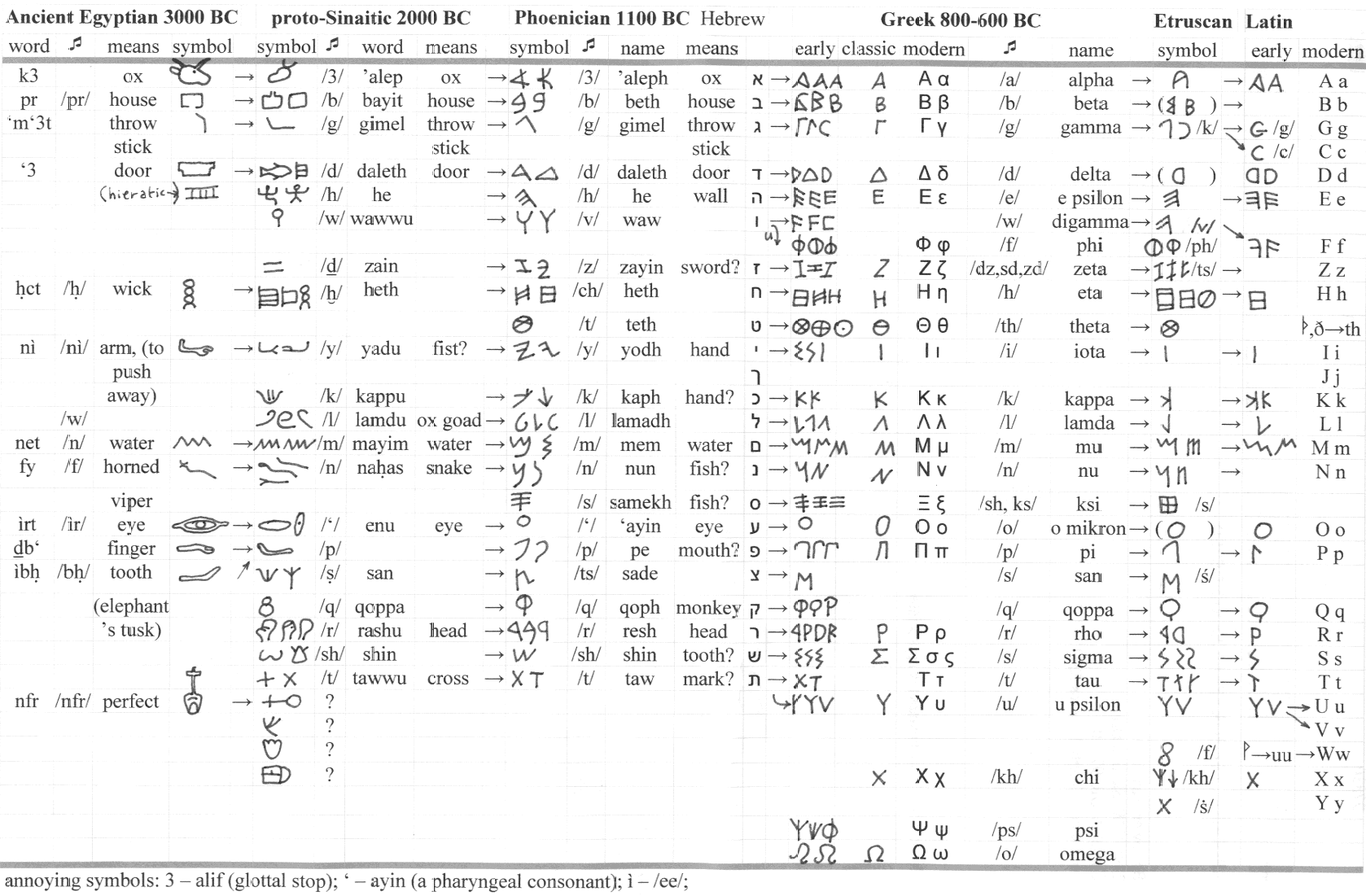
First of all, look back at the alphabet .gif. F has two equivalent letters: phi (Φφ), where it gets its sound and the secondary letter digamma (Ϝϝ), where it gets its appearance. Digamma (so called because it resembles a double Gamma Γ) may be unfamiliar to you, but it is indeed a Greek letter, albeit one that fell into disuse sometime around the seventh century before the Common Era/Anno Domini. Yes, it was disregarded that long ago, and its influence is still present.

The reason digamma was not forgotten is that the Romans had a peculiar habit when they spelled things: they differentiated the words they took from outside origins. The reason the word chaos is pronounced with a k sound is because English took it from the Roman spelling, which was taken from the Greek khaos. Similarly, the Romans took digamma, flipped it around and used it for their “f” sounds, except when that word was Greek in origin. Then it kept the phi-influenced ph spelling, as in phobia.

That makes F one of the newer letters on the block, made by the amalgamation of a letter that sounded like “waw” with a sound like phi. The old waw pronunciation of digamma also gave way to u, v, and w, although those three symbols came from a different origin. In linguistic terms, F is called a labio-dental surd (lip-teeth voiceless, because it’s a breath-sound made with your upper teeth on your lower lip).

And right now, you're all making the "ffff" sound to see if that's true. 

Sources
The Facebook page on waw/wau (Yes, there is such a thing).
Dictionary.com (because no matter how many times I do this, I forget what surd means).

Tuesday, June 28, 2011

Distractions, Distractions


This may surprise you, but it’s a choose your own adventure game. It’s a short story called Thousand Dollar Soul, made into a flash for Newgrounds (it’s what is referred to as “interactive fiction” : ). It’s about a high school kid named Todd who’s visited by a future version of himself, who came back, ostensibly, to help Todd change his life. But, depending on your choices, you might start to wonder about Future Todd’s motivations.

You can go through it as many times as you want. In fact, you should go through it more than once as the only way to learn about what’s really happening is to piece together what you learn from the different paths. There are 35 endings in total and a handy list to check which ones you’ve gotten.

Over all, it’s a fun experience. It’s my kind of story: one you have to think about and discuss in order to comprehend completely. One final warning: it’s a bit violent. But I still recommend it as an interesting read.