Tuesday, August 9, 2011

Websites for Writers

Yes, I’m still doing this : ). I bet you were lost without it. Anyway, a while back I stumbled across this gem by Storyfix.com.

Basically, it’s a list of questions you should be able to answer by the time your book is complete. Note: not your first draft, not your fifth, not your fiftieth; when it is COMPLETE. Between each draft, you should be able to answer more of the questions. Just keep in mind that you shouldn't try answering all of them in one draft.

There’s not much else for me to say. The post really speaks for itself. I strongly advise you to bookmark it and periodically check it against your story, whether you’re in the writing or editing phase.

Now if you’ll excuse me, I have some questions to answer…

Sunday, August 7, 2011

Review: ROOM

Since I did two rants last week, I figured I’d treat you all to a book review. Because it’s fun.


I was very excited when I won ROOM in a contest, because I heard such good things about it. And, I’m glad to report, it lives up to the hype. Without giving any spoilers, I can say it’s a story about a young boy named Jack and the world he lives in. The spoilerific specifics of his life reminded me of Plato’s The Allegory of the Cave  (which is briefly mentioned in the book).

What was really interesting was Emma Donoghue’s writing style. The book is told from the point of view of a five-year-old, and as you’d expect from a young child, it is very narrow and literal. For example, little Jack’s description of a toilet tube maze is: “We’ve been making Labyrinth since I was two, she’s all toilet roll insides taped together in tunnels that twist lots of ways.” Everything in his life isn’t an object, it’s a name and to him, the only of its kind.

She captures Jack perfectly, but because of this, the book can be a bit disorienting at times. Subjects change rapidly, things are described but not explained, mostly because as a child, Jack doesn’t need an explanation. He’s okay with things just being. Unfortunately, it was a little disruptive to me as the reader. I felt sometimes like I was talking to Jack instead of experiencing everything myself, that I wasn’t “in” the book.

It’s one of those things you just have to deal with, though. I think the book was supremely written. About half the book is pure dialogue, but like the narration, this only adds to the feeling of Jack telling his story, like all of this is beaming straight from his head into mine. I definitely recommend reading this. It’s an experience that won’t easily leave you.

A really neat online version of the room itself can be found here, along with information on the book. Very neat.

Friday, August 5, 2011

Secret Origins: G

G, like C, is one of those funny consonants that has two different pronunciations. It can be soft, sounding similar to J, as it is in gem or gym, or hard, like it is in gam or gum. Also, it’s sometimes part of words that don’t end in m.

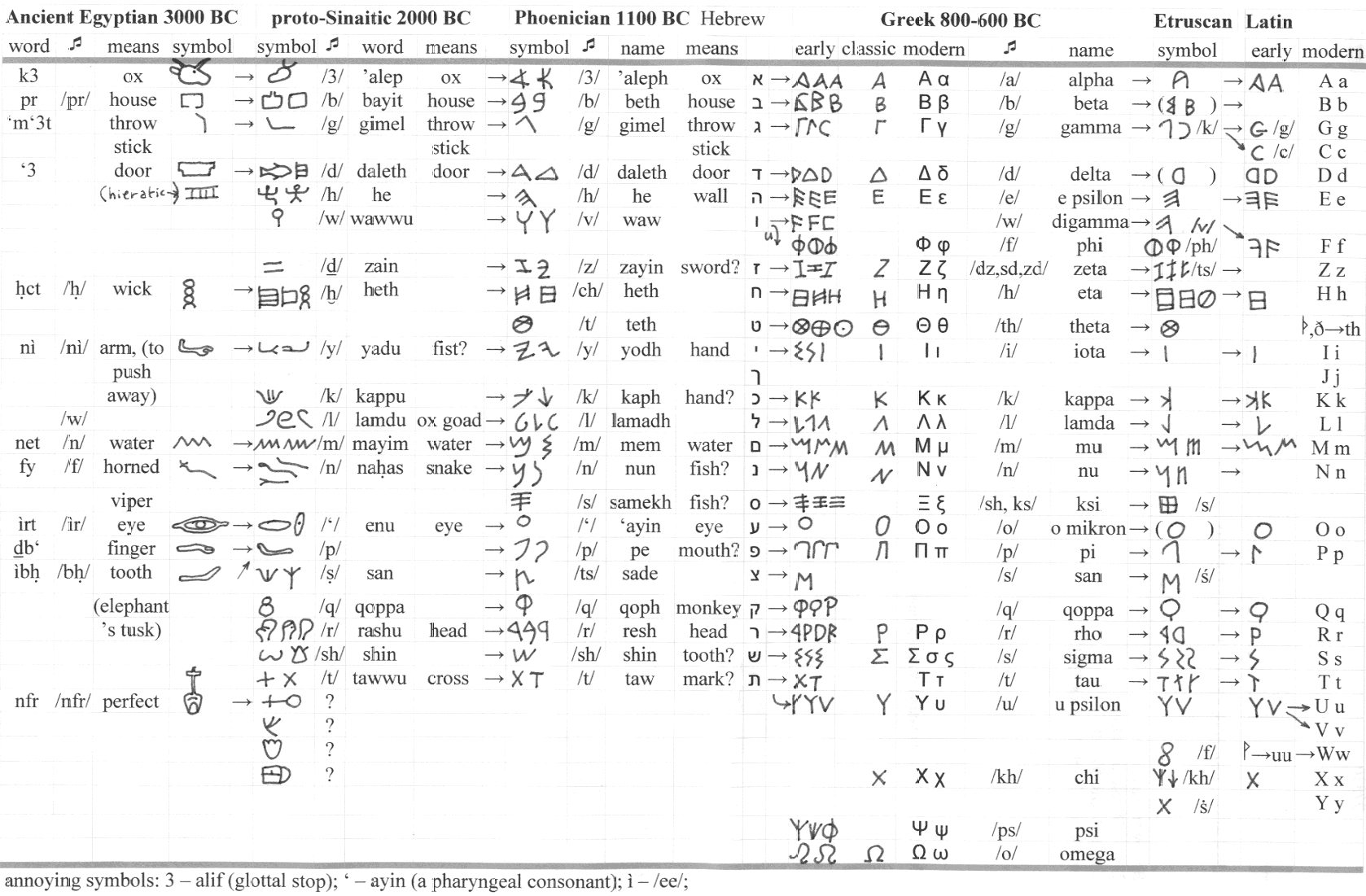
We’re going back to the .gif again, aren’t we?

Darn right. It’s probably not surprising that G comes from gamma (Γ or γ) and because of that, its history is the same as the letter C. Gamma comes from the Hebrew letter gimel, ג, which as you can see, looks a lot upside down lowercase gamma. Hebrew is an old language, originating more than a thousand years before the Common Era, and it stems from the language of the Phoenicians. Now if you look back at the .gif, you can see the Phoenicians’ gimel was a lot more similar to the upper case gamma, except reversed and leaning backwards. This symbol is in fact sort of a pun: gimel means camel in Phoenician, but the symbol is of a throwing stick, or giml. Like the rest of the Phoenician alphabet, it was derived from Egyptian hieroglyphs.

Okay, so that gives us the origin of gamma, but as I mentioned in an earlier post, gamma encompassed the letter C and all the soft c sounds with it. Where, and how, did it become its own letter?

After the Greeks made their alphabet (around the eighth century Before Common Era), they spread it to the Etruscans of Italy. The Etruscans were the ones who changed the “guh” sound to “kuh”, and when the Roman Empire rose, they absorbed that alphabet, creating Latin. But this left them without a sound for “guh”, so they decided to add a stroke to the letter C and make a new symbol, giving us G. So there is a reason they look similar!

So that’s how G was born, but what about the “juh” sound of it? Is it only there to mess with people trying to learn English? Originally, g was always hard. But then, an accidental overdose of gamma radiation altered its body chemistry and a startling metamorphosis occurred. Similar to C, G has been palatized, except it isn't constant based on the following letter. Look at gentle. And gird. No one who grew up speaking English says gen-tell or jird.

The different pronunciations are on a word-by-word basis because English is a Germanic language with many other influences. Words of Germanic origin (like Germanic itself!) usually have the hard G. Words of Romance (i.e. French) origin usually follow the soft-hard rules of the Irish Gaelic: hard before or after a, o and soft before e and i. Note that I said usually. Look at margarine. It precedes an a, but you say it soft.

If you ever hear anyone from another country pronounce a g wrong, correct them, but be gentle. It really is freaking confusing. It's like we're looking into a world of madness. There are no rules. Cats chase dogs up trees. Hamburgers eat people. The sky reflects the orange color of the ocean. Pandemonium!

Thanks to these sources:
Phoenicia.org, for info on all things Phoenician.
Omniglot, an excellent source on alphabets.
The Alphabet Gif, as always.
Ancient Scripts, an excellent authority on…ancient scripts.
Charlton T. Lewis and Charles Short’s A Latin Dictionary from Tufts University's Digital Library.
Encyclopedia.com, for their information on hard and soft G. 
The Online Etymology Dictionary, for showing us that words can and do break the rules.
And Dictionary.com. Because palatize is a weird word.

Tuesday, August 2, 2011

Won’t Somebody Please Save the Children


Has the world ended yet? No? Because people were grandstanding in order to further politicize the country and get people on their side because that’s the only thing they really care about?

Yeah, that’s what I thought.

Anyway! Today, because I feel like it, I’d like to talk about censorship. Yes, again. But I’m not going to go on about it for four days this time. I just want to say that I think the children can handle 20 BOY SUMMER and SLAUGHTERHOUSE-FIVE. Oh but they’re keeping SPEAK (to the disappointment of one man…).

First, they’re talking about banning S5 because of the “crude language” (yes, that’s take directly from the article)? I have to ask, have any of these people ever been teenagers? Are they honestly saying they didn’t let loose a blue streak the second the adults were out of the room? Because I did. My friends did. Granted, it wasn’t nonstop cursing, but we never hesitated to use one. Sometimes we through one in there when there was no reason for it. Because we could.

They’re also upset about the violent content. Okay, maybe I get that. But it’s not like it’s there for the hell of it. We’re not assigning kids violent pornography to read; it’s actually part of the story, part of the meaning, part of the point.

Then, they’re critical of 20BS because “included questionable language, drunkenness, lying to parents and a lack of remorse.” No way! Get out! Teenagers never feel that way/do that stuff! And even if they did, we can’t have characters who are actually like them. That would be wrong.

You can bet I’m swearing right now. Come on! Parents: isn’t all that typical teenager behavior thing many teenagers do? Can you really tell a story like 20BS and not have “irresponsible behavior”?  

Books are powerful, there’s no question about that. But they act like these books are demoralizing kids and I would give them more credit than that.

I know I don’t have kids so I can’t speak for what it’s like to teach and influence them, but parents, don’t they take more from their environment? From you?

Sunday, July 31, 2011

More Complicated Than You Think

There has been sooooo much talk recently about the debt ceiling, and how we’re going to default, and how the world is going to descend into a post-apocalyptic hell similar to the books I write. Which might actually hurt the market for dystopian. Hm.

What’s my opinion on all this? I have no freaking idea what to do. I’m not an economist, a finance wizard, or a politician who pretends that I am these things. What I know about the situation is what I’ve gleaned from the newspaper and Comedy Central.

It’s not that I don’t care about what’s going on. I do. I just don’t know how to solve it, and I’m sure no one person can. But still, the media (social and otherwise) will be filled with people claiming that it’s just this easy, all they have to do is raise the debt ceiling/raise taxes/lower taxes/cut spending/call China and tell them the check is in the mail but you know how slow delivery is just be patient would we lie to you? Just as writing isn’t merely putting words on paper, fixing this isn’t merely waving our hand and magically fixing the economy.

Not that I begrudge anyone from expressing their opinion. The free exchange of ideas is important! We should talk about it, throw around solutions, and just listen to what others have to say. I just hope everyone keeps in mind that there are factors of which we are unaware and our brilliant ideas might not actually work the way we think.

In conclusion, if you don’t have a possible answer like me, that’s okay. If you do, that’s fine too. Just remember to listen first, ask questions second, and be kind third. Finally, when all else fails, here’s a picture of kittens:

Works every time.

Friday, July 29, 2011

It’s Webster’s Fault


I always thought it was weird that British and American English can be so different, yet from the same root. I know that languages evolve over time—I’ve only said it every week for the past nine months—but it has always surprised me how different some things can be. There’s realize and realise, color and colour, paralyze and paralyse, traveled and travelled!

What brought about these differences? Short answer: Noah Webster. Apparently, he wanted the two countries to have their own styles, so he ran through the dictionary cutting out letters he felt weren’t needed or were confusing. The double l and u above reflect the former example, while the switch from s to z shows an example of the latter.

Changing all this stuff might seem silly, but I’m sure the fact that the American Revolution just ended and he was looking to distinguish his country from England had nothing to do with his decision to write the American Dictionary of the English Language.

Or, you know. Everything.

Regardless of his motives, he did work hard on thedictionary, for which he learned 26 languages, traveled Europe, and wrote 70,000 entries.

All that because he wanted everything to be accurate! And that attention to detail is also why the dictionary is still used—who do you think is the Webster in Merriam-Webster?—and why the spellings prevailed here in the United States.

I guess that mystery is solved.

Thanks to:
Netstate’s page on Noah Webster.
The online version of Webster’s 1828 American Dictionary of the English Language.

Tuesday, July 26, 2011

A Day of Fanfare and Jubilation

This is an open call for guest posts for the last full week in August. For what reason, pray tell? Because that Friday, exactly one month from today (because months don’t come in regular intervals…a matter for another post) is the glorious day of jubilation known as my BIRTHDAY (caps required). So if you’re interested in reaching a slightly different audience of writers or maybe have something you want to promote, shoot me an email.

It might sound horrendous, but I’m not doing a giveaway for my birthday. The shame! But I do have a reason! My blogiversary is coming up in less than three weeks, so it seems kind of silly to have one contest right after another. Don’t worry. It will be AWESOME.

Speaking of which, any ideas on how to make it awesome? Gift certificates? Gift cards? Books? Leave any interesting ideas in the comments section. About the posts, please contact me by email if you’re interested. And on my birthday, I’ll eat a slice of cake for each one of you.

Seriously. I’ll do it. I love cake.

Love it.