Thursday, March 22, 2012

Language of Confusion: Leed or Led


I got this idea from William’s comment last week in my easily confused words post. Lead and lead are spelled the same but pronounced differently depending on the context, as in “Lead on to the lead paint.” Or, phonetically, “Leed on to the led paint.” As you surely remember, I went over a similar situation with read and read. To sum up, read is pronounced two different ways because the word’s ancestor was, and the two pronunciations are used to distinguish two different tenses.

However, in this case not only are the tenses different, but we have a completely separate word involved. Lead the metal comes from the Old English lead and Western Germanicloudhom, which is thought to be from the Old Irish luaide(so from Ireland to Germany and back over to England!). The Irish word is thought to come from the Proto-Indo-European ploud, which means “to flow,” which only makes sense if they’re talking about molten lead, but who knows? It was kind of a long time ago (only about five to eight thousand years…).

The other lead (as in, in the lead) also comes from Old English, but a different word, laedan. This word can also be traced to Western Germanic, laidjan which means “to go”, and further back, the Proto-Indo-European leit, with the same meaning.

So as for the pronunciations and spellings, it’s all probably coincidence, just like in read and read. I blame the “ea” combination for having so many different ways of being said.

Sources

Tuesday, March 20, 2012

What I’ve Learned


Lately, I’ve been thinking of reusing an old idea I had, one from a book I discarded long ago. The book itself isn’t great. The characters aren’t very distinct, there’s no real antagonist, and honestly I have no idea who the audience for it would be. It’s just a great big blah in manuscript form.

But the core idea, which involves time travel, might still work. It would have to become a plot thread in a whole new book though, meaning ninety nine percent of that effort would be discarded. Basically, I’d be back at square one with it.

It’s kind of a daunting prospect. Part of me whines “I already did this once! I shouldn’t have to do it again!” But I know that salvaging any other part of this book is impossible. It’s either a new effort by a (I hope) more experienced writer or it continues to linger on in the limbo of my idea file.

It happens. Some books don’t work, no matter how much you want them to. Heck, some ideas don’t work no matter how much you want them to. I can tell you that I’m not doing it again without a clear, workable plan in mind. Not necessarily plotting (I’m still a confirmed pantser!) but rather the assurance that I won’t make the same mistakes.

Have you ever tried to reboot a new idea? How did it go? Has experienced helped you evaluate your ideas?

Saturday, March 17, 2012

Random Thoughts


---You might think writing a post like this is easy, but thinking up words to fill these spaces is very difficult. Like I’m doing right now.
---I love the first few days of spring, when it’s warm and fun to enjoy. Before I have to spend the next four months battling wave after wave of the ant invasion.
---There are ants out there that cultivate a fungus (farming…a scary enough prospect for beings with a brain smaller than a pin) that they use as a glue to build a tiny tower that’s full of holes (architecture…even more frightening). What’s the tower for? To catch bigger bugs. They work together, each hole filled with an ant grabbing onto the larger insect while other ants go and sting it to death. Sleep well.
---They’re coming for you.
---Does anyone under 18 ever not click something that says “Only click if you are 18 years old or older”? EVER?
---When I hear middle aged people complain about how “rude” younger people are, I know it’s the same ones who bitch at the barista for giving them the wrong flavor of coffee when it is, in fact, what they ordered. Shocking. People tend to be rude to rude people.
---Best moment ever: while working in a deli, a woman chewed me out because her heated tuna fish sandwich was cooled (amazingly enough, things can get cool very quickly). Then she yelled at me for adding peppers to the sandwich. I insisted that I did not. She pointed to a green blob and yelled “There! What’s that?” To which I calmly replied: “Celery.”
---My reasons for preferring online newspapers to actual ones can be summed up by what I think of the comics page: the local newspaper rarely debuts comics that haven’t been running for the past fifty years, so I was surprised when they got rid of the boring and ridiculous Rex Morgan MD and replaced it with the actually entertaining Gil by Norm Feuti. It’s almost unthinkable. A comic strip I actually enjoy! And of course people are writing to the newspaper to complain about it for the audacity of having actual characters in a realistic modern setting. Heaven forbid there be some innovation in the newspaper comics.
---Newspapers are great to use to clean windows. So that’s one thing they have over the internet.
---Whenever I hear “I deeply regret” used in a sentence, I know it’s got to be from a politician.
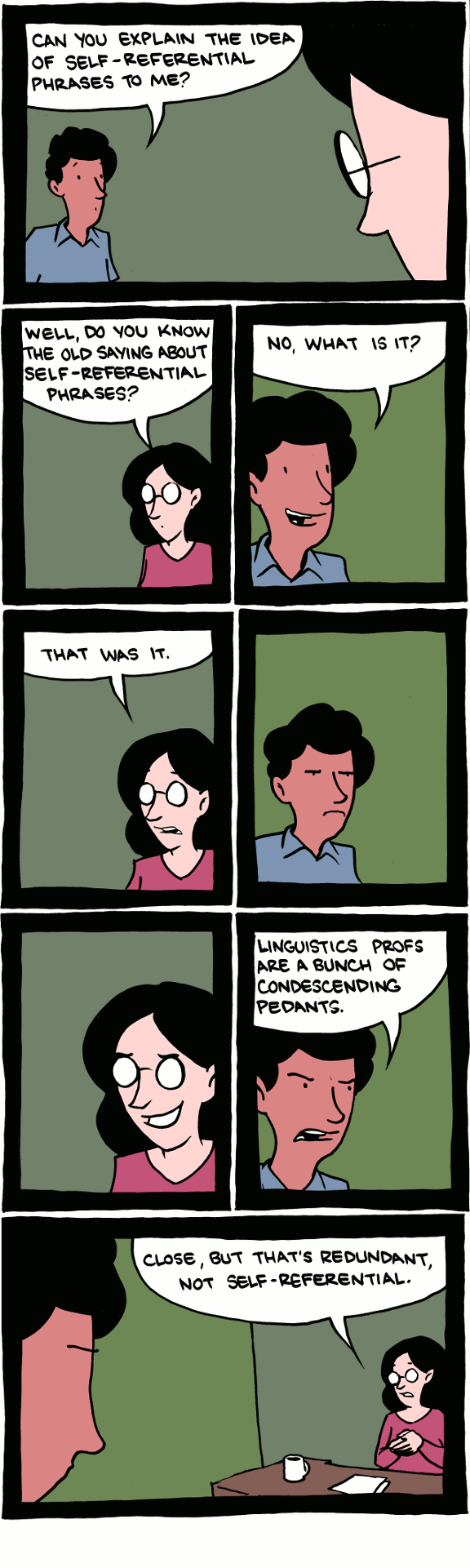
---Finally, I thought this was hilariously apt:

Thursday, March 15, 2012

More Words That Are Easy to Mix Up


Maybe it’s because I visit forums too much, but I see words used wrong all. the. time.

Hm. I’m thinking there shouldn’t be a “maybe” in that sentence. Anyway, while using words in an incorrect, yet socially accepted manner isn’t a bad thing, although it might push people’s editorial Berserk Buttons. Will misusing them cause dismissal by an agent/editor/publisher? Probably not. But then, what do I know? It’s not like I’ve been published.

Perpetrate/perpetuate
This is one of those that’s easy to confuse because of similar spellings rather than misinterpretation. Perpetrate is to act, while to perpetuate is to continue forever. But switch that u for an r and boom! Wrong word.

Hopefully
I have to admit: this one drives me crazy. And I have no idea why. I guess I’m annoying like that. But hopefully means “in a manner full of hope” and people tend to use it in sentences like “Hopefully no one figures out I’m slowly poisoning them with arsenic.” If you put in a synonym like confidently, surely or optimistically, the sentence descends into meaninglessness. It would be more correct to say “with luck” or “I hope”. Then I can sleep at night because a word wasn’t misused.

Lie/lay
I’m actually much better at using this word than I used to be. The rule that helped me is that you yourself lie down, but you lay something else down. This is really confusing because the past tense of lie is, wait for it, lay. Yes, “An hour ago, he lay down and went to sleep” is correct, at least in the past tense. Note that this is only for the recline sense of lie. For the untruth sense, of course this rule doesn’t apply because that would make things slightly easier.

Perverse/perverted
I’m sure we could go to the Online Etymology Dictionary and find out that these two words are related. However, as they are used today in the English language, they are slightly different. Perverse is more doing something that is wrong on purpose, like saying “I’m going to lay down” when you’ve just read the above paragraph. If any of you are parents of teenagers, think of pretty much anything they’ve said to you ever. Perverted on the other hand has a more negative connotation. Perverse may be willful wrongness, but perverted is completely twisted against all that we know is right.

Lightening/Lightning
Obviously, people don’t confuse these two subjects. They do, however, confuse the spelling. I check my manuscripts for each of these because at least once per book I’ve messed them up. I blame my left middle finger. It should know that being shocked isn’t caused by lightening but it presses that “e” anyway.

Overall, this probably doesn’t matter much. Language evolves the way it wants to. Or rather, the way we want it to. Maybe I should start driving a word differently and see if it catches on.

Tuesday, March 13, 2012

Square Cube Law


Have you heard of it? If you haven’t, I wouldn’t be surprised. I hadn’t heard of it until it was mentioned in Atomic Robo (and if you haven’t heard of that you must start reading more awesome comics).

Basically, it says giant ants can’t exist because their bodies would never be able to support them. Considering that ants are already poised to take over the world with their little, tiny bodies, I think the fact that they can’t get any bigger is a big load off our minds. Anyway, the reason the creators of Them! were thankfully wrong is because as something gets bigger, it’s volume increases exponentially. Something that’s two times bigger has eight times as much volume.

To illustrate, I’m afraid I’ll have to use math:
The volume (V) of a cube is the length of one side (L) multiplied to the third power, so L­3. If L equals 4, V equals 64. If L equals 20 (5 times an L of 4) then V equals 8000 (125, or 53, times a V of 64). This works for any formula volume, whether sphere, cone or anything else.

The same applies to anything. If an ant is made bigger by, say, gamma radiation, whatever its size is increased by (2, 5, or whatever number), the volume is the cube of that (8, 125, or whatever3). But the ant has its original body structure, because what is this? Some kind of magic radiation? And that body structure cannot sustain the increase in volume. It would be crushed by its own weight.

This same principle applies to any building, animal or ship your characters will use, so keep it in mind before creating any gigantic titans battling over the ruins of New York City. Or dinosaurs.

Saturday, March 10, 2012

Distractions, Distractions


Just for the sake of preventing you from writing, here are the best websites out there that will completely mesmerize you.

            It doesn’t just have TV. Movies, games, books—they’re all in there. You’ll start by maybe looking up a favorite book, like one of the Harry Potter books, and see all the things in it that have been used before. Then you’ll notice a funny trope and you’ll have to check out all the different ways it’s been used over the years. You’ll spot an old TV show you used to watch and wonder what tropes it is associated with. And so on. And so on. FOREVER.

            This site is also known as “I read the comics so you don’t have to.” Josh posts and comments on various newspaper comic strips, from the unintentionally hilarious dramatic strips (you should see him when he gets started on Mary Worth), to the painfully bland comedic strips (well, they’re supposed to be comedic, although I’ve never laughed at most of them). It’s easy to spend hours looking through the archives because Jeff is hilarious.

            Like I don’t mention this enough. But it’s worth mentioning since if I’m ever supposed to be writing but not, I’m probably on Newgrounds playing one of the games. And if the game has pointless achievements, then I can’t leave until I have them all. Although that may be due more to OCD than to the game.

And soon, my plan will come to fruition. You’ll all be trapped on the internet while I become the emperor of the world. Mwa-ha-ha!

Thursday, March 8, 2012

The Language of Confusion: Provision


What brought this one? The fact that I wasted so much time futzing with my blog design that I had to reach back for a pre-written post? Possibly.

Shockingly enough, provision does not mean being a proponent of eyesight (that’s actually pro-vision). Yes, it is distantly related to both pro- and vision, although the prefix and suffix were together long before modern English came to be. Provision showed up in the late fourteenth century, although the definition of something provided didn’t show up for another century, and specifically relating to food came just after that. Originally, it was a church word for naming the successor to a position before said position was vacant (it was literally providing beforehand). 

It comes from the classical Latin provisionem—foresight—which is from providere, the ancestor of provide. Providere, meaning to prepare or look ahead, is indeed a combination of the prefix pro- and videre. The former, in addition to meaning “in favor of” also means before. Videre is the origin word of visionand means to see. Yes, I can see you are all surprised. Combine together, and you get “to see before” or perhaps, to be prepared for the future.

There is one more word we’re going to look at in this family: improvise. In this case, the prefix im- (a variation of in-) means not or the opposite of. So instead of being prepared, it’s being unprepared, like when you jump onto a stage and just start doing stuff.

Also, interesting to note, provision is a word. Provising is not. Improvising is a word. Improvision is not. Coincidence? Yes, completely. But the divergence of words is quite amusing to me.

Sources
Dictionary.com for telling me what ecclesiastical means. Now that’s a vocab word for you.