Thursday, March 30, 2023

Language Of Confusion: Maximum Carnage, Part III

We’re back looking at words from the Proto Indo European root sker-, to cut. So far, the words have all had carn- or cur-/cor- in them, but now it’s time to look at words that also have an S in them, just like their progenitor.
 
First, score, which does look a lot like sker-. It showed up in the late fourteenth century meaning to score a point, but it showed up even earlier as another word for twenty—they definitely are related, I’m just not really sure how it went from twenty to just tallying (maybe they were tallying by twenties?). Both come from the Old English scoru, which is from the Old Norse skor, a word directly from the PIE.
 
Then there’s scar, which actually has two meanings, a mark on skin and a cliff face, and… the skin marking might not be from sker-. The skin mark showed up in the late fourteenth century, and while it might have been influence in some way by score, it doesn’t seem to actually be related to it. The other scar showed up later, in the seventeenth century (though it showed up earlier spelled scarre, just like the skin scar was). It’s from the Old Norse sker, a rocky path at the bottom of the sea, from to Proto Germanic sker-, which of course is from the PIE sker-. So a cut in the bottom of the sea is related, a cut in a mountain is related, but a healed cut in skin is not related.
 
Scrape actually makes a little more sense in this regard. It showed up in the early thirteenth century as scrapen and meant to erase with a knife, and in the fourteenth century to remove the outer layer of something with a tool. It’s thought to be from the Old Norse skrapa, to scrape or erase, from the Proto Germanic skrapojan, and Proto Indo European skerb-, which is from sker-. Scrap is very close in origin, having shown up in the late fourteenth century, from the Old Norse skrap—so missing the last vowel. And skrap is actually from skrapa, so it all ties together nicely.
 
Here’s one that might make a little less sense. Scrabble showed up in the mid sixteenth century, but back then it meant to scrawl or scribble, (at least the name of the game Scrabble makes more sense now) or scrape at with your hands, before meaning to struggle in the seventeenth century. It’s from the Dutch schrabbelen, another word from sker-. Also possibly related is scramble, which showed up in the late sixteenth century and is thought to actually be a variant of scrabble. When it showed up, it also meant to struggle along (not meaning to toss together until 1822) so it does make sense. I mean, kind of.
 
Sources
Online Etymology Dictionary
Omniglot
University of Texas at Austin Linguistic Research Center
University of Texas at San Antonio’s page on Proto Indo European language
Tony Jebson’s page on the Origins of Old English

Tuesday, March 28, 2023

From The Spamfiles

It’s still March! More spam!!!

Message from UPS (copyright symbol) saying they’ve been trying to reach me, please respond, with a box emoji at the end.
Though the fact that it has a box emoji in the message kind of undercuts any legitimacy from the copyright symbol after UPS.

Message from some weird, random email address saying my Bank Of America EDD debit card has been locked.
It’s probably good that my BOA debit card been locked considering I don’t have one.

Message from Peoplewhiz, saying one thing all cheaters have in common, brace yourself.
The one thing all cheaters have in common is that they’ve cheated. Mystery solved. Not that I’d listen to anything from a place named Peoplewhiz.

Another message from Peoplewhiz! This time saying this 13 second trick (how oddly specific) catches any liar, with the word addicting in parentheses, and everything is bolded and italicized.
So… it’s addicting to catch liars? Is that the message this is trying to convey? Also if anything, it taking thirteen seconds seems longer than it should to figure out if someone is lying.

Twitter follower, DotaGuy5, with a picture of a bed as the profile pic and “let’s try all” in their bio, has once again started to follow me.
Just to inform you that the DotaGuy is still periodically popping up to follow me on twitter. He’ll disappear for a while, then a notification pops up that he’s back. I cold easily block him, but at this point I’m just trying to see how long he’ll keep doing it for. At this point he’s been doing this for at least a year and it’s getting impressive that he’s still trying.

Saturday, March 25, 2023

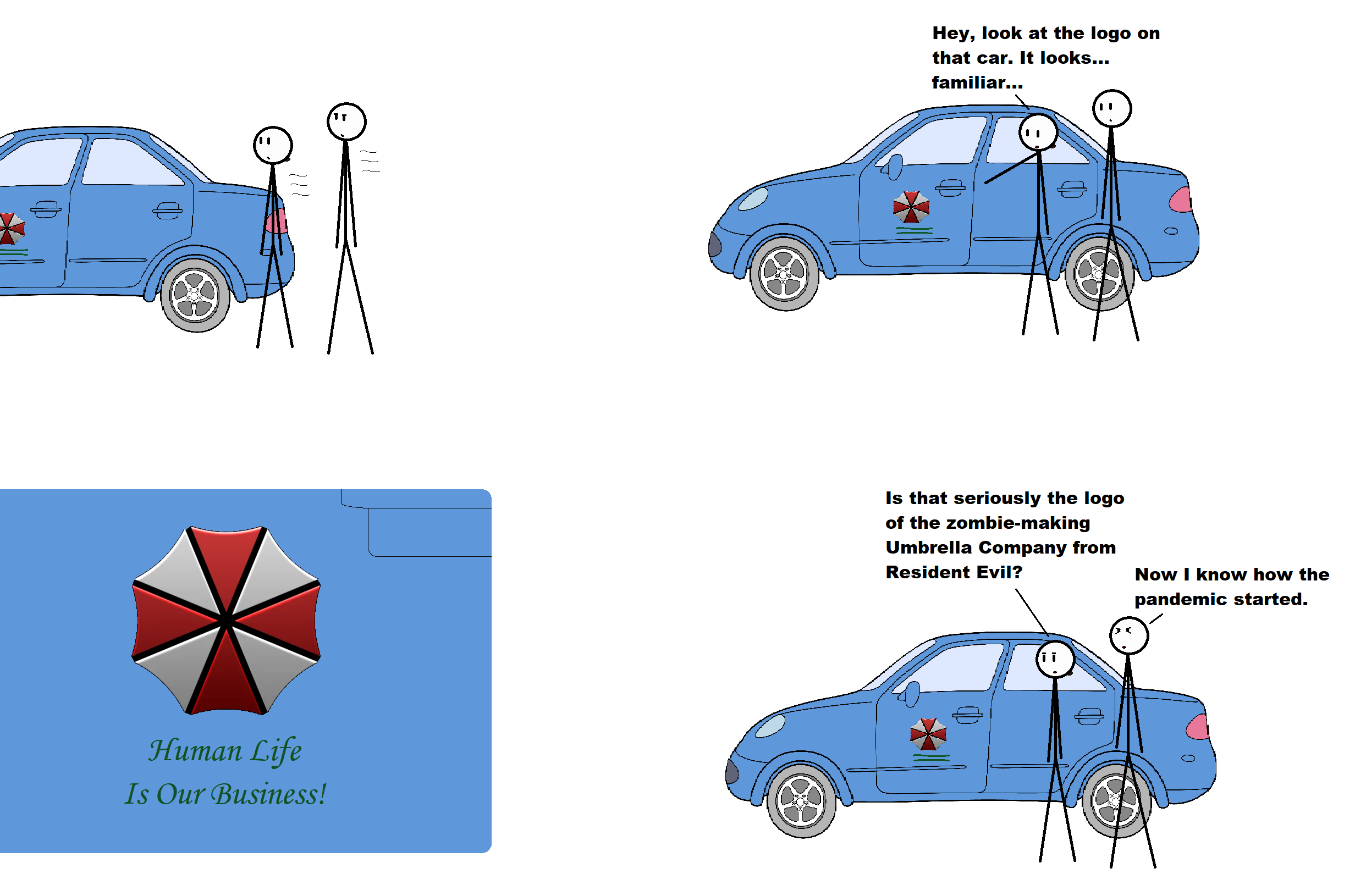
Umbrella

I know nothing about the owner of this car, but I wish I did.
Panel 1, a friend and I are walking along when we pass a car, Panel 2, I say, “Hey, look at the logo on that car. It looks… Familiar…” which has an emblem and something written on the side, Panel 3, close up of the door, which has the Umbrella Company logo from Resident Evil plus the words “Human Life Is Our Business”, Panel 4, I say, “Is that seriously the logo from the zombie-making Umbrella Company from Resident Evil?”, Friend goes, “Now I know how the pandemic started.”
For those unaware, that’s the logo from the evil, zombie-creating Umbrella Corporation from the Resident Evil video game series. I should’ve taken a picture!

Thursday, March 23, 2023

Language Of Confusion: Maximum Carnage, Part II

We’re back at looking the Proto Indo European root sker-, to cut, and all the crazy words descended from it.
 
First, curt showed up in the mid fourteenth century (where it was actually spelled court), from the classical Latin curtus, short. You cut something short, you’re curt. Straight to the point on this one, isn’t it? Curtail is actually from the same place, though it showed up later, in the late fifteenth century. It actually has a slightly different history, coming from the Old French courtault, which is of course from curtus.
 
But that’s not nearly weird enough. Now, a currier—not a courier, which delivers things—is a person who dresses or dyes leather. It showed up in the mid fourteenth century from the Old French corier, from the classical Latin coriarius, leather worker, from corium, leather. Now why did I explain this obscure word you’ve probably never heard outside of a last name? It’s actually related to the word cuirass. That word showed up in the mid fifteenth century from the Latin phrase coriacea vestis, leather clothes, and that’s also from corium. Cuirasses, as in the armor, started out being made of leather, which is cut flesh, so now we have two words we hardly ever use these days.
 
And we can get weirder! The word crone, like an old lady, is from sker-. It showed up in the late fourteenth century, from the Anglo French carogne, which meant carrion or a carcass. So yeah. Not exactly a flattering term for an old woman. It’s from the Vulgar Latin caronia, which means carrion. Because they were insulting old women by calling them dead bodies, we have crone.
 
Finally today, there’s cortex—and all the words related to that, like cortical or corticoid. It showed up in the mid seventeenth century, meaning outer shell or husk in botany, not being used in relation to human anatomy, specifically the brain, until 1741. It’s from the classical Latin cortex, which means tree bark—the outer shell of the tree. Not really sure how the outer shell of something evolved from sker-, but it did.
 
Sources
Online Etymology Dictionary
Google Translate
Omniglot
Dictionary.com
University of Texas at Austin Linguistic Research Center
University of Texas at San Antonio’s page on Proto Indo European language
Fordham University

Tuesday, March 21, 2023

From The Spamfiles

What day is today? Spam day! Your favorite! Or maybe it’s mine.

Message from Ann Johnson saying they’ve got a charity proposition for me.
No one would ever use a charity as part of a scheme to enrich themselves! Mostly because the charities do that themselves.

Message from Mr Charles Renata that says Hello friend, how are you today? Hope all is well with you and your family? And yes there’s a question mark after family.
My dear friend Mr Charles Renata (no period after Mr. obviously), always wondering about me and my family?

Message from Mrs. Dara, saying RE: May God bless you, and addressing me as beloved one
It just wouldn’t be spam day without a cancer widow trying to give me her money. All I have to do is send her a few thousand dollars for taxes!

Message from Carlagoti1 at alice.it saying RE: your USD 550,000, to whom it may concern, my email won.
Emails are always winning half a million dollars in contests they never entered. That’s just how the internet works.

A Tumblr user named Towell-aoeveline has followed me, she is a Capricorn, South (mushroom emoji) Carolina highschool (all one word) slut
There is not a single piece of this I don’t find disturbing. Especially the emojis.

Saturday, March 18, 2023

The Devil’s Corners

Rounded corners are an abomination.
Panel 1, I’m in front of my laptop looking mad and I say, “Great, the latest Windows update broke the fix I used to turn hideous rounded corners into sane, correct angled ones.” Panel 2, squinting, I say, “Looks like the only solution is to gouge out my eyes so I don’t have to see them.” Panel 3, I sigh and say, “No, that’s crazy. I can’t do that.” Panel 4, I’m getting up and leaving the room and I say, “Obviously the solution is to head down to Microsoft headquarters and start gouging out their eyes.”
Not as bad as when one of their updates literally broke my computer, but still an offense. Now where’s the melon baller?

Thursday, March 16, 2023

Language Of Confusion: Maximum Carnage, Part I

Today I think is a good day to start looking at the words descended from the Proto Indo European root sker-, to cut, of which there are many, with increasing levels of WTF. You know, like how these things usually go.
 
Carnal showed up in the fifteenth century meaning physical, human, or mortal, and shortly after also being used to mean sexual. It comes from the Old French carnal and classical Latin carnalis, carnal, sensual, or of the flesh. It comes from carnis, which literally means “of the flesh”, and it’s believed that since it was related to caro, a cut of flesh, and it’s from sker-, which means to cut. So a word that meant a literal piece of meat now means sexual. That’s a good sign.
 
Carnage at least is not related to sex. I mean, I hope not. It’s a bad sign if it is. Anyway! It showed up in the seventeenth century from the Old Italian carnaggio, slaughter or murder, from the Medieval Latin carnaticum, which means slaughterhouse in classical Latin. It’s from carnem, flesh, from sker-, because you cut flesh.
 
Carnivorous showed up in the mid seventeenth century, while carnivore didn’t show up until 1839. Both words are from the classical Latin carnivorous, which just means, you know, carnivorous. The car- part is from sker-, while the vorous part is from vorare, to devour, from the PIE gwora-, food or devour.
 
Next is one you’re probably going to be skeptical about: carnival. It showed up in the mid sixteenth century meaning the time of merrymaking before Lent—so, like, Mardi Gras or Carnevale. It didn’t actually mean a carnival like a fair until 1926! It’s from the French carnaval and Italian carnevale, with the carn- from caro and thus sker-, and the rest from levare, to lift. No, I don’t know how “to lift flesh” got to mean a party before Lent, let alone a fair. I’m sure there was a lot of meat eating there, but still.
 
Carrion certainly makes more sense. It showed up in the early thirteenth century, making it the oldest word yet, and it even had the same meaning we use it as. It’s from the Anglo French carogne, from the Vulgar Latin caronia, which is from caro, and so from sker-. Strangely consistent for such an old word.
 
Finally today, incarnate, which showed up in the late fourteenth century. It’s from the Late Latin incarnatus, and the classical Latin verb incarnare, to incarnate… or make flesh. Another one that’s been fairly consistent. Kind of a boring note to end on, but nothing can really top carnival, the meat festival.
 
Sources
Online Etymology Dictionary
Google Translate
Omniglot
Dictionary.com
University of Texas at Austin Linguistic Research Center
University of Texas at San Antonio’s page on Proto Indo European language
University of Texas at Arlington
Tony Jebson’s page on the Origins of Old English
Old English-English Dictionary
Dictionary of Medieval Latin
Encyclopaedia Britannica
University of Ottawa, Canada
Fordham University
Orbis Latinus