Thursday, October 13, 2011

The Language of Confusion: To the Mandatorium!


Many words contain variants of manual, which comes from the classical Latin manualis, belonging to the hand, and can even be traced back to Proto Indo European as men-, which of course means hand. It would take forever to find and list all the manual words, so today I’m focusing on a particular subset: those related to the word mandate.

Mandate first showed up in the sixteenth century, a creation from the classical Latin mandatum, which means order. The word is a past participle of mandare, a combination of manus(hand) and dare (to give).  And yes, dare is the classical Latin word for date. It was the Romans who first started using it as a specific time.

Now, although mandate seems like the predecessor of other –mend words, it’s actually not. At least, it isn’t in English. This might seem weird, but this happens a lot. So many of our words already existed in other languages and were taken as they are needed. For example, demand first appeared in the late thirteenth century, more than two centuries before mandate. Similarly, command appeared in the thirteenth century and remand showed up in the mid fifteenth century. Reprimand and mandatory, however, did come after mandate. There’s also countermand, which I’ve never heard of before. But it doesn’t get a red squiggly line under it in Word, so apparently, it’s well used enough to be in that dictionary. Awesome points to anyone who can name a book where the word has showed up.

One thing these words all have in common is that they came from French first (well, not mandatory, that was straight from Late Latin). There is the Old French demander (to demand), comander (to entrust or instruct) and the Middle French remander (to send an order) and reprimende (a noun meaning, unsurprisingly, a reprimand). Each of those words showed up at a different time, too, as they were based off Latin.

For the most part, languages borrow from each other because, well, Occam’s razor applies to words as well. It’s easier to take the Latin demandare and switch it to demander and then demand rather than come up with a whole new word for require a specific task. Even “new” words like email and Facebook are combinations of existing words.

That’s language evolution for you.

Thanks to: 
Dictionnaire du Moyen Français (1330-1500) (I can't really read French, but even I know that says Dictionary of Middle French). 
John Garger's Article on Brighthub: The Golden and Silver Ages of the Latin Language: The Classical Latin Period.
And Christine's Latin Webpage.

Tuesday, October 11, 2011

Powering Through


I sat down today knowing I had to write. But—incomprehensible!—I didn’t want to. For me, editing can be as fun as first draft writing, but it can also be a punch to the throat. I look at paragraphs and, with hate, go “Why won’t you do what I want? You sound blah and I’m not even sure you make sense. Why won’t you behave?”

This happens a lot when I’m bogged down in editing. A wall just appears in front of the screen, blocking me from getting to my book. After these bouts, I take a small break that I usually force myself to come back from. But even just a few minutes can knock down the wall covering the screen. I can power through, see what isn’t working and find a way to fix it. And what comes out usually isn’t half bad.

Unfortunately, this doesn’t always work. There are times—and I don’t this unless I absolutely have to—I give up, figuring it’s best to wait and see if my crit partners have the same feeling towards it. By the time I hear back, then enough time will have passed that I’ll probably be able to edit better.

Your thoughts? What do you do when you hit a block writing or editing? Do you have any tricks for getting around the wall?

Writing is easy. Writing well is hard.

Wait, have I already used that one? Eh, whatever.

Saturday, October 8, 2011

The Seven Stages of (Critique) Grief


First of all, I’d like to say how wonderful the feedback was from the people who read my books. It’s amazingly helpful. None of this refers to you in any way. Promise!

But what I’ve noticed upon receiving a critique is that one (because I’m not willing to admit that it’s actually me) goes through several stages. Not unlike grieving. So here it is, the seven stages of critique grief:

1. Denial—In this stage, you read the critique and know that obviously, they didn’t get what you were going for. How dare they doubt you going on for three pages about what was going on in this minor character’s life while he waved at the main character’s girlfriend. Plus, your sentences, like, totally make sense. Or whatever. You’re a great writer. They just don’t understand you. Nor do these writers have any idea what real writing is even if they’ve been at this longer than you’ve been alive. Fools!
2. Anger—Your book is great! It’s all great! Your book is a national treasure. Once the offers start pouring in, you’ll wave them in your so-called critique partners’ faces. And anyone who can’t write a perfect novel in the first draft should be launched into the sun. What kind of idiot doesn’t know they were tense jumping or misappropriating words?
3. Fear—Oh no. What if you really didn’t write a good novel? What if you screwed up? What if all those jumps through time don’t make sense? What if you really are POV-hopping? What if all your delightful, quirky characters really don’t add anything? No! It can’t be! The ellipses are beautiful! The repetition is wonderful! Semi-colons! Nooooo!
4. Bargaining—It won’t matter. So what if you have a few mistakes? An agent would understand. If you can just convince one to read the whole story, they’re bound to love the potential. If you can get one to request a partial, he or she will surely love it as much as you do. Please. Even if there are thousands of other stories out there with authors willing to spend months or even years pouring over every single word until it snap, crackle, pops…if you’re just given a chance…
5. Guilt—Well, you’re useless. All those people who spend all that time working on their novels…no wonder you can’t catch any interest. It’s all your fault. You wouldn’t listen when people made suggestions because you thought they just didn’t get it. If only you tried harder to clean up those rambling sentences, those strange words that stomp through your novels, and the tangents that go nowhere, like the flashback to the hero’s birth even though it’s a first person story, even if it adds so much tension. Maybe then it would be readable.
6. Depression—Nothing matters. The book is hopeless. All those ideas, even the good ones, are meaningless because you have no talent. It just isn’t worth the effort to make it readable. Sure, you could fix all those problems the critiques pointed out, but there were so many! And if you made them the first time, what’s to say you won’t just make them again? Are you just supposed to keep working on it and expect it all to be sunshine and roses?
7. Acceptance—Shouldyou keep working on it? You thought it was utter crap, and maybe it is, but that doesn’t mean it can’t be made into notcrap. Yeah, it’s a lot of work. But you already put a lot into it. Don’t you want something to be proud of? And you were smart enough not to send of those letters comparing your critique partners to zombies who only wanted to eat the brains that is your novel, so maybe you could ask them to look through your rewrites and make sure you’re on the right track and not making the same mistake. It almost seems possible.

Thursday, October 6, 2011

The Language of Confusion: Shugar


Isn’t the word sugar weird? And sure? We pronounce it “sh” but there’s no H! They’re dogs, but they’re playing poker!

Anyway, what is the reason behind this mysterious fit of pronunciation? Or is it just one of the many things that was pronounced one way a thousand years ago and people kept it even though the spelling changed and it became nonsensical (because that never happens)?

Sugar—the substance, not the word—has been traced back to New Guinea (north of Australia) sometime around 9000 BCE. It spread to India around 500 BCand stayed a closely guarded secret until Arab expansion over a thousand yearslater in 642 CE. That’s how important it was. People kept their lips zipped until they were unzipped by force! And it didn’t spread to Europe until five hundred years after that, during the Crusades.

Being the spice that controls the universe, the word stayed surprisingly similar among most languages. It begins with a s or z sound, has a hard consonant like k or g in the middle, and has an r sound at the end. It ranges from zucker in German, to sheqer in Albanian, seker in Turkish, azucar in Spanishand sukari in Swahili. Yes, I know these are all in the Europe/Asia area. I haven’t learned non-Latin letters. Yet.

In English, the word sugar first appeared in the late thirteenth century, adapted from the Old Frenchsucre  and traced back to the Medieval Latinsuccarum and the Arabic sukkar. It might go back further, but because the Arabs were the first to spread the substance, it’s possible their word also took. In Indonesia  and Malaysia, where the substance was first cultivated, both languages use the word gula for sugar.

But that leaves us with the mysterious “sh” sound. In Old French, sure is sure or seur. That would have been pronounced like “se-yure,” and English kept the y influenced pronunciation. They just softened it to a “sh.” Apparently, the same thing happened with sugar.

References
Etymology Online for the information on sugar and sure.
John Garger’s article at Bright Hub
Google Translate for its many variations of sugar.
For the history of sugar:
Florida Crystalstimeline on the history of sugar.
Essortment’s page on the history of sugar.
Sugar Knowledge International Ltd.’s page on the history of sugar.

And of course, The Simpsonsfor giving us about eleven laugh-full years. Plus another fourteen or so.

Tuesday, October 4, 2011

Websites for Writers


Writer’s Digest is a source worthy of its own post. Today I’m just going to focus on a particular part of it. Chuck Sambuchino writes an excellent blog called the Guide to Literary Agentsand…are you checking it out yet?

He’s got a post on almost everything. One article has links to three of his Query Letters That Worked (a recurring feature). Another is a great source if you’re having troubles organizing your story ideas. And crafting a hook! I always need help with that.

There are also articles on new agents, by agents, and by authors on how they got agents. Hey, the blog is called Guide to Literary Agents. What did you expect? And if you want more advice, check out the blogroll. It’s really the best of the best there.

So what do you think? What are your favorite writing websites?

Saturday, October 1, 2011

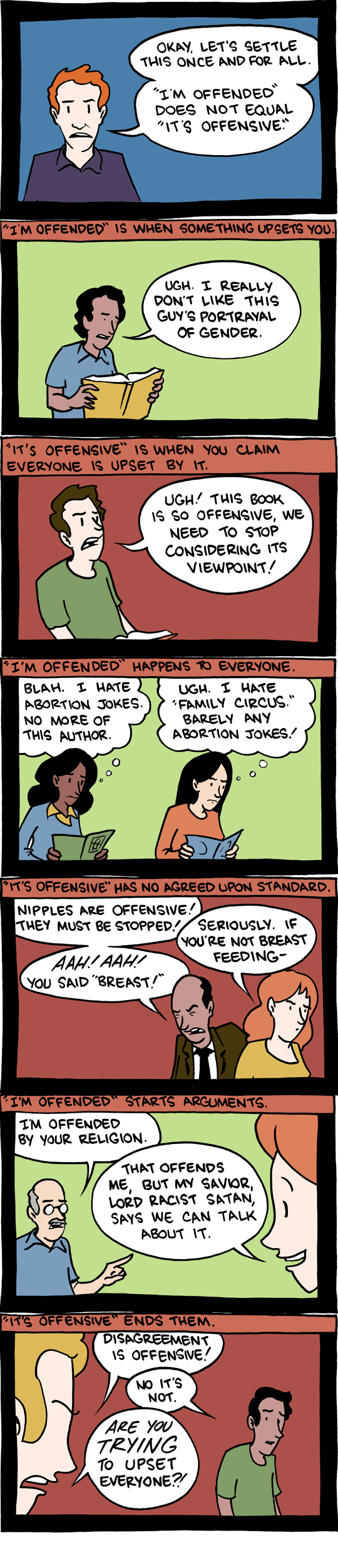
I’m Offended


“It offends me” is a whole other beast from “It’s offensive.” The former indicates that something bothers me and I’d prefer not to see/hear/experience it. It also indicates that I am the one with the problem and while I think this is wrong, I acknowledge that others can experience it if they choose—as long as it has nothing to do with me.

“It’s offensive” implies that it is near-universally appalled and that even mentioning it is distasteful. While there are things that fall into this category, it’s important to remember that something that bothers you is not necessarily in it.

One of the arguably unfortunate things about the world is that no matter how horrible something is, some @$$h0le somewhere is going to find it funny. Now, this doesn’t mean you should bite your tongue when something that bothers you pops up. You just have to remember to acknowledge that others think differently. Engage in debate—civil debate—ask it to be removed or whatever. And if someone says something you did offends them, offer them the same courtesy.

It’s frustrating, but one of the prices of free expression is that people can do things that piss you the hell off. And unless we all want to go Harrison Bergeron, we have to tolerate it. Unless it’s illegal. Then, yeah, go nuts.

Finally, I’ll leave you with the inspiration for this post, which probably makes the point better than I ever could:


Ever notice I use a lot of the same sources? It’s because I want people to think I’m smart, so I cite smart ideas of others. But it’s no big deal. Because that’s how academia works.

Thursday, September 29, 2011

Secret Origins: H


Because it’s been a long time since I’ve done one. Or at least, it feels like it’s been a long time. Well, it’s my blog and I can do whatever I want.

H is another one of those weird letters that has more than one pronunciation. Although in H’s case, it’s more like either pronouncing it or just having it there for show rather than two separate ways of speaking it.

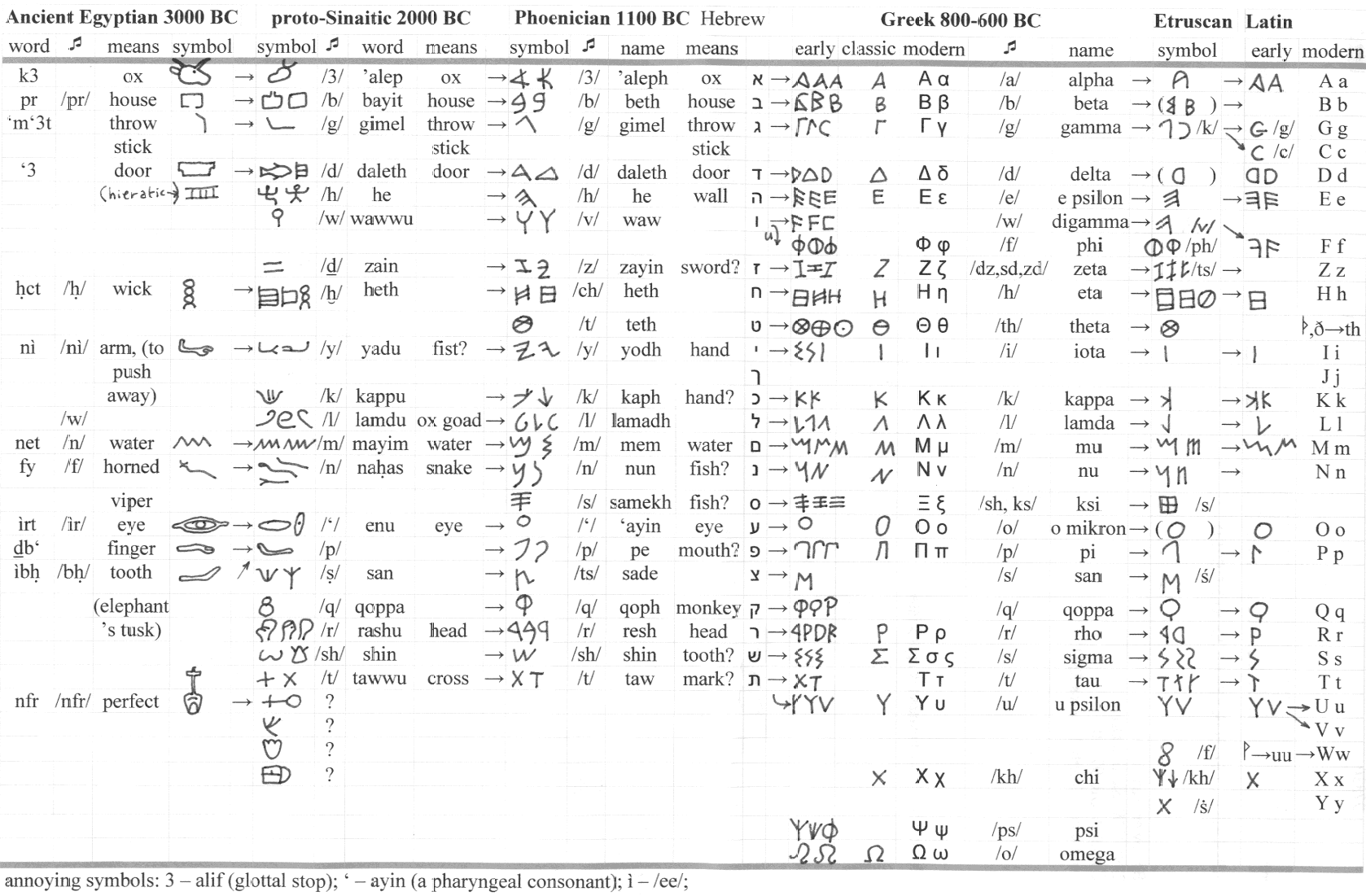
The symbol origin of H is easy. In Greek, capital Eta is Η and the lowercase, η, is kind of like an h without a flag sticking out (or an n). The Greek symbol in turn came from the Hebrew ח heth, not all that different from lowercase eta. And now the pronunciation is back again! If you look at the alphabet .gif, you’ll see that heth was also a Phoenician letter symbolized by what looks like H with the top and bottom connected (also apparent in early Greek versions of eta). However, before that, in the proto-Sinaitic times, it was rounder, more like a twisted piece of string. Appropriate since in Ancient Egypt, the symbol meant wick.

Okay, so that’s the symbol, but what is up with the pronunciation? That’s the tricky part because throughout the years, different languages treated H differently. Let’s go all the way back to about 1900 BC, when proto-Sinaitic, the first alphabet, was formed. They used Egyptian Hieroglyphs as a basis and as you can see here, H was originally used for the “he” sound. Phoenician and Hebrew evolved from proto-Sinaitic and both still had the sound.

Then around 750 BC, the Greek alphabet appeared. If you look at their alphabet, you’ll see they don’t have an H sound at all. That’s because many Greek dialects just didn’t have rough, back of the throat noises like “aitch”.

The beginnings of Latin involved the Etruscans. Their alphabet was based on the visiting Greeks’ and so also lacked an h sound. While classical Latin did use the rough h sound, Vulgar Latin, the more common form, did not. And since the more common language would have been mimicked by French and Italians they conquered, the Romance languages didn’t use the hard H, either. Possibly due to Germanic influence, English did, even pronouncing H on words that didn’t used to have it (herb). Although, there are a few words (like heirand hour), that keep the Latin silence.

TL;DR: Some languages make throaty sounds like H, some don’t.

Sources
Omniglot’s pages on the proto-Sinaitic, Greekand Etruscan alphabets
Nick Nicholas’ post on Greek